Showing posts with label Historical Fiction. Show all posts

Friday, April 11, 2014

Summer of My German Soldier

Author;  Bette Greene
Published:  1973
ALA Notable Book
National Book Award Finalist
NY Times Outstanding Book of the Year
I read Summer of My German Soldier when I was a young girl, but I could not remember it.  I do remember loving the book and loving Anton, the German soldier, but I couldn't remember why.  I know why now, he loved Patty, the main character in the book.

I was reminded of the book as I read Lily's Crossing, but I couldn't tell how or even if the two stories were related, but they definitely are related.  Let me tell you about the book first and then I'll tie the two books together.

Patty lived in Arkansas during WWII.  This book is historical fiction, and it really helps the reader get a sense of the feeling toward anyone who is different.  There is prejudice against Nazis, Jews, blacks, Japanese, Chinese, and the poor.  The book starts at the train depot as everyone is waiting for POWs from Germany to arrive because there is a camp for the POWs in Jenkinsville, Arkansas.  Everyone is excited because no one has ever seen a "real Nazi" before.  "Even Chester, the only Negro, was now standing in arm-touching contact with whites."  The hatred toward Nazis is not the only hatred in this book.  I could tell right away that race relations were a problem in this town where Mr. Lee and his family are run out of town because they are Chinese.  The townspeople are very ignorant and say, "Our boys at Pearl Harbor would have got a lot of laughs at the farewell party we gave the Chink." 

The main character is Patty.  She is a very open-minded 12-year old girl.  She cannot understand why Mr. Lee is run out of town.  She says, "All I know is that if Mr. Lee had been Japanese, then it might have made more sense.  Anyway, there's probably a simple logical explanation.  It couldn't be what I think."  Patty is always trying to find the best in everyone.  Patty has a beautiful little sister named Sharon, her father owns a shop in town, and her mother is the most beautiful woman in the town and works with her husband at the store.  The people in the town consider this family peculiar because they are Jewish, but they seem to be working out in the town because of the shop and the mom's beauty.  Patty and Sharon are home for the summer and Ruth, the black housekeeper, is taking care of them. 

The reader learns that the ugliness in the community is not only in the community, but also right in Patty's home.  Her parents hate her.  They don't like that she asks questions, that she has frizzy hair, that she is always trying to help, that she doesn't seem to care about frilly clothing, and that she has friends that are poor.  Patty is so lucky to have Ruth.  Right at the beginning of the book we wonder about Patty and her relationship with her parents.  "Sometimes I hear my mother tell [Ruth] to lose weight.  'It's not healthy to be fat.' But she isn't actually fat; it's just that she has to wear large sizes.  I mean, it wouldn't be Ruth if she were like my mother.  And another thing, a little extra weight keeps a person warm inside."  These statements made me wonder if Patty's mother was cold inside.  Throughout the book Patty fantasizes about receiving love from her parents. She fantasizes that her parents will come to appreciate her and "tell me how much they love me - how much they have always loved me."  Right afterward, Patty's mom is talking to a customer and tells the customer, "you'd expect two sisters to be something alike, but Patricia doesn't care how she looks while Sharon is just like me."  Patty thinks, "Didn't Mother know I was still standing there? ... Oh, mirror, mirror on the wall, who's the homeliest of them all?"

Patty is desperate for love and affection.  When the POWs visit her father's store, Patty helps one with his purchases.  He is very sweet to Patty and so she prays to God, "Oh, God, would it be at all possible for Frederick Anton Reiker to become my friend?... but if this is something you can't arrange then could you please keep him safe...?"  It is no wonder that a few days later, when Anton escapes from the prison camp and Patty sees him fleeing that she protects him and houses him in a room over the garage that is not used.

Anton and Patty form a very close relationship in the few days he is in the garage and they love each other.  They share dreams with each other, communicate, and protect each other.  Anton sees how Patty's family treats her and witnesses the abuse from her father first hand.  He leaves the security of his hiding place to save Patty, but she begs him to not interfere for his own safety.  "Using my arm as a shield, I looked up.  I saw the hate that gnarled and snarled [father's] face like a dog gone rabid... I gave myself to the sidewalk.  Between blows I knew I could withstand anything he could give out, but once they came, I knew I couldn't."  "Anton was dazed with horror and ran back to the garage." 

Eventually, Anton realizes that he is putting Patty in danger by letting her hide him and he leaves.  He is wearing one of Patty's father's shirts so when he is finally captured and killed, the FBI puts the story together and finds Patty.  Patty has to deal with her parents, the community, the legal system, and the loss of Anton.  When she goes to reformatory school, the only person who visits her is Ruth.  She realizes that she was lucky to have Anton's and Ruth's friendship and love.  Patty also realizes that Ruth was "her life raft," but she had to save herself.  She finally knows that her parents do not love and never will.  She will have to rely on herself.

I think that this book came to mind as I read Lily's Crossing because they are both set during the same time period, but they both really have nothing to do with WWII.  Both books are about the importance of kindness, love, friendship, and family.  Lily and Patty are both in desperate need of love.  Lily finds love and friendship in Albert who is also in need of a friend.  Patty finds love and friendship in Anton, a very good person, who needs Patty to survive just as much as she needs him. 

I fell in love with this book again.  The friendships are so necessary in such an ugly time in our history.  Even though I love this book, this is not a book I will put in my class library.  The language is strong and I'm okay with my students reading strong language, but understanding the hatred behind the language is something the children might not understand.  The ages for the book are listed as 10 and up, but I think this is a book meant for middle school and older.  The description of the abuse that Patty suffers, both physically and emotionally, is very intense.  This book would be emotionally difficult for a 3rd grader to read and understand.  On the other hand, Lily's Crossing has a similar theme, and is at a level that the 3rd graders can understand.

Check this book out from the library.
Bette Greene
Independent Reading Guide

Monday, April 7, 2014

Lily's Crossing

Author:  Patricia Reilly Giff
Published:  1997
Newbery Honor Book
Had this book been written when I was a child, I would have read it and loved it.  I played out in the "woods" in our backyard at Andrews Air Force Base.  I spent my summers jumping over the creek, climbing trees, and pretending with my friends that we were in a fantasy world.  Lily, the main character, is that kind of girl.  She made up stories about her aunt being a spy and the neighbor was a Nazi spy, she pretended to be an author, she snuck into movie theaters to watch movies without having to pay, she swam out in the ocean and paddled around in a boat.  I liked reading about her life.

Lily has an exciting life with a father, Poppy, who loves her, and a grandmother who cares for her, but she cannot remember her mother who died because she "had something wrong with her heart.  It was too big.  She died right in Poppy's bedroom on a sunny day."

Lily does not really have friends until the summer that she meets Albert.  She had another summer friend, Margaret, but Lily considered her perfect because Margaret didn't really know Lily.  Margaret didn't know that Lily was terrible in school, told lies, and didn't have any other friends.  Lily and Margaret start the summer off together, but Margaret must leave because her father is going to work on bombers in Detroit.  Soon after D-Day, Margaret's brother Eddie, who is fighting in France, cannot be accounted for.  The family cannot bear to return to the summer house, but Lily has managed to make another friend, a true friend, Albert.

Albert had been Hungary and had to escape at the last minute because his parents had been writing a newspaper that was against Hitler.  He and his sister, Ruth escape to France.  Ruth becomes ill and is taken to a convent to live while she recovers, but Albert continues his escape to Canada and then the United States.  Albert worries for Ruth and wants to find a way back to France to be with her.

Lily's father is an engineer and he agrees to enlist so that he can help with the rebuilding process.  Lily must spend the summer with her grandmother at the summer house.

During the summer, Lily and Albert form a strong relationship.  Lily agrees to teach Albert to swim so that he is able to swim to one of the boats that passes by on its way to France for the war.  Albert wants to get on a ship and find his way to Ruth.  Lily promises to teach Albert to swim and then she will go with him so she can find her father in France too.  Lily knows she is lying to Albert, but she cannot help herself.  She loves to lie, or really just make-up exciting stories. 

At the end of the summer Lily returns to her home and to school.  She is no longer the bad student because she has a teacher who supports her amazing imagination.  "Sister Benedicta had told he that all writers did that [day-dreamed] and that as long as you knew the difference between lies and daydreams you were in good shape." 

During the school year Poppy returns.  While he was in France he had the opportunity to meet Ruth because Lily had written about her.  Ruth was waiting for the war to end to go to Canada and be with Albert again. 

Once school is over, Poppy, Lily, and her grandmother return to the summer house.  Margaret is still not there, but Albert has returned and this time he is with someone else, Ruth.

This book is very different from Prisoner B-3087 because it is told from a different point-of-view.  This is the point-of-view of a girl who misses her father because he is at war and it is about how she grows and matures because of her experiences and new friendships.  There is a daily fear of losing a loved one and not knowing whether the loved one is safe.  I used to teach at a school made up of all military children.  It reminded me of all of the deployed parents and how my children struggled through the school year without mom or dad to tuck them in, watch the grade-level shows, or even just help with homework.  I think military children (around 5th grade) would relate to Lily and enjoy reading about someone in a similar situation.  Lily's Crossing ends with a note from the author.  She writes, "I wanted to tell my readers that even though the times are different now, people have always worried about the same things...loss and separation, the future, and sometimes war.  I want readers to know that love and friendship make a difference."   This book is similar to  Prisoner B-3087 because we encounter the same themes.  Yanek lost everything because of war, he missed his parents, and had to figure out what to do with his future after the war.  I worried about my dad in the military as a child, I worry about my own boys and their future, and my students still suffer and struggle with missing parents because of deployments, separations, divorce, ... These are things that we all can relate to because they are things we all struggle with regardless of age or culture.

As I read this book, something seemed so familiar.  This book was published in 1997, so I know it wasn't that I had read this book as a child.  I know that as I child I had read something similar.  I did some research and found another book, The Summer of My German Soldier.  I cannot remember exactly what this book was about.  I remember that a girl hid a German soldier in her attic.  She was keeping a secret from those around her.  Like Lily, helping keep the secret that she and Albert were going to escape to France.  I ordered the book and should get it tomorrow.  I seem to remember enjoying the book.  I'm looking forward to reading it and seeing if there are any ties to the two stories.  I'll let you know.

Check this book out from your library.

Sunday, April 6, 2014

Prisoner B-3087

Author:  Alan Gratz
Published:  2013
Timeline of WWII
 (*this is where this story begins)
 This story begins in Poland in 1939, when Jakob is 10 years old.  Jakob is called by his Polish name, Yanek.  Yanek is with his family enjoying a meal and showing his family a movie he has made.  This is a happy start to a terrifying story from WWII and what this boy endures for 6 years.

He says, "If I had known what the next six years of my life were going to be like, I would have eaten more.  I wouldn't have complained about brushing my teeth, or taking a bath, or going to bed at eight o'clock every night.  I would have played more.  Laughed more.  I would have hugged my parents and told them I loved them."  These are all of the things he misses throughout the next six years.  That very night, the night he is with his family, Germany reaches Krakow.  Yanek's father is always hopeful and Yanek believes him.  Yanek's father, says, the war will be over in 6 months, the war will be over in the winter, the war will be over by spring.  Yanek's mother and father do not live to see the end of the war, 6 years later.  By then, Yanek is a man.  He only has memories of laughter, of brushing his teeth, of sleeping and not being hungry, of his family.

"German soldiers filled the streets of Krakow. 
They marched in their smart gray uniforms with
their legs locked straight and thrown out in from
 of them the way ducks walk.  It was silly, but
 eerie at the same time." (p. 7)
Yanek is a smart young man who loves his family, American movies, and to read.  Soon after the Germans arrive in Krakow Jews are no longer allowed to go to school, the movies, or even the library.  The Polish boys would no longer play with him.  Wasn't he Polish too?  A wall is built around their city and all of the Jews are forced to live in the homes - sometimes four to five families in one small home.  He is no longer considered Polish, he is no longer even considered a human.  He is considered a Jew which is considered less than human, less than even animals.  "I was an animal to them, a pack mule...Working animals were expensive.  They had value.  I was a Jew" (p. 108). The vocabulary in the story refers to the Germans as their "masters."  I thought of my dog.  The Jews are herded from camp to camp, travel in cattle cars, and are fed warm water and old bread with maggots.  In the 6 years this book covers, Yanek works in 10 different camps and miraculously, his life is spared.  There were so many times that he should have died.  These 6 years were like a roller coaster ride I have never ridden on and hope to never ride.  He is hopeful and defeated and hopeful again within minutes.  "I vowed not to be killed without a fight.  My father, Uncle Moshe, the Jewish elders, they were all wrong.  We shouldn't be trying to survive, we should be trying to win.  Instead of waiting for the British or the Americans or the Russians to save us, we should be saving ourselves" (p. 109).

This story reminded me of The Book Thief in parts because Death seems to be a character in this book as well.  Yanek is surrounded by death and murder.  There is no reason for the deaths he sees and he becomes numb to the horrors.  "Death and I had become old acquaintances.  We knew each other when we passed on the street.  This man was dead, I was sure" (p. 155).  Yanek has a will to not just survive, but to win against the Nazis.  He faces death throughout his 6 years, but Death listens to his pleas and leaves him alone."  As Allies bomb the Germans, Yanek along with the other prisoners keep their heads down and wait.  Yanek was "whispering to death, pleading for it to pass me by yet again."  This is his 10th camp.  He walks out because in addition to Death fleeing, the Nazis fled and the Americans arrive.  Finally, an American soldier tells Yanek that everything is going to be all right and for the first time in a long time, Yanek believes that everything will be all right.

I have been noticing a lot of references to books not just in this book, but in other books we've had to read lately.  I don't think I had ever noticed before the importance of books and words.  I know books and words are important, but I had not noticed that books just flat out tell me.  Books and words are what save people.  The sticks and stones saying is so wrong.  Words can hurt and words can save.  Luckily, for Yanek he loved reading, "any and all books.  But especially books about America, and books about doctors and medicine" (p. 9).  He knew what he needed to eat to survive.  He knew what to trade so that he was eating what his body needed so he could avoid the Nazi clinics.  No one that went to a clinic ever returned. 

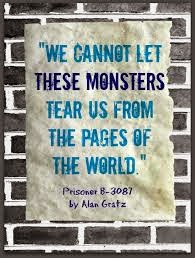
On the night he becomes a man (bar mitzvah) he must read from the Torah.  Yanek realizes that being caught with a book, especially the Torah, "he would never become a man, he would be shot dead on sight" (p.45).  A book is how Yanek describes his life.  His life is a chapter of a bigger book and he does not want the pages of the book to not include his life.  "We cannot let these monsters tear us from the pages of the world."  Yanek fights to survive and his words are not torn from the pages of the world.  His story is secure in the pages of this book, Prisoner B-3087. 

I do not like reading about people suffering and definitely not about history.  This story was about suffering and history, but it was definitely worth my time to read.  The suffering endured by Yanek, his family, and all of the prisoners during WWII is horrifying, but I was able to read about it in this book because Yanek was so hopeful.  He fought to survive and I cheered him on throughout the book.  He was a compassionate person even when those around him were not compassionate.  He tries to save his friend Fred when he cannot get up because Yanek knows he will be killed.  Yanek helps a young boy walk from one camp to another even though he himself does not have enough food to sustain himself or energy to carry himself.  Yanek even feels compassion towards animals who are mistreated by the Nazis.  At a time when he is seen as less than even an animal, he has compassion towards all life.  His compassion, his desire to live and to love others makes this book easy for me to read even though I fear these types of stories and the sadness they make me feel.  There is a lot of loss and death, but the will to go on is inspiring.

As I read I looked up words that were unfamiliar to me and times and places that were unfamiliar.  I learned that WWII didn't start with just Hitler and Germany, but Japan attacking China, Italy attacking Africa years before Germany starts its invasions.  I learned about the different concentrations camps and never realized that people could have struggled in camps for years upon years or that people were shuffled between camps for no reason at all except for physical and psychological abuse.  I knew that people suffered, but seeing it from Yanek's point of view, I can only begin to understand the terror, sadness, and the numbness he felt by having to witness his family taken and family and strangers killed.  I am amazed at how little reference there is to anger.  Yanek experiences the anger of the Nazis, but I do not hear about his anger.  We are so quick to anger and to react without thinking.  Yanek had six years to think, but he if he was angry, he had to control it or he would die and others would die too. 

I look forward to sharing this book with my boys.  This is definitely a book for middle school and high school children.  Children exposed to this type of literature would love learning about history and would also learn about compassion and empathy.

The Afterword in this book tells us that Yanek was a real person and his story is true, but this is historical fiction.  The story was written with Jack Greuner's (Yanek's American name) blessing. 

Video of Jack and Ruth Gruener


Tuesday, April 1, 2014

The Witch of Blackbird Pond

Author:  Elizabeth George Speare
Published:  1958
Newbery Medal
The Witch of Blackbird Pond is set in 1687 in Connecticut.  This is a story of Kit Tyler, a young girl and her first year in America.

Kit Tyler was raised by her grandfather in Barbados.  Both of her parents died when she was young and she could not remember them.  She had a good life in Barbados with her grandfather who taught her to read, to swim, and bought her the latest styles of clothes.  When Kit's grandfather died, she had no one to go to except to an aunt she had never met who lived in Connecticut.

On her journey from Barbados to Connecticut, Kit met several people who would eventually impact her life.  She met Prudence, the young daughter of Goodwife Cruff.  Prudence was abused and did not know how to read.  She met Nat, the son of the captain of the ship, The Dolphin.  Finally, she also met John Holbrook, a young divinity student who was planning on studying under Reverend Bulkeley, a strong supporter of the King of England and a doctor.

Kit missed Barbados and the life she had there, but she grows into a young woman who realizes the importance of every person.  She meets Hannah, the "witch," who is labeled a witch because she is a Quaker and she lives in a shack near the pond.  She is not understood, but feared in the community.  She is an outcast because she does not go to church on Sundays and because she is a Quaker.  Hannah is helped by Nat, eventually by Kit, and Prudence.  Kit helps Hannah survive a witch hunt, teaches Prudence how to read, and falls in love with Nat. 

As I was reading the text for the class, I remembered how much I hated social studies in school.  I couldn't force myself to remember the names of battles, dates, the order of events.  I really struggled.  I realize now that I really could have loved social studies. (My husband always wonders how I ended up being a Foreign Affairs major in college!)  Reading our text, I learned that I am not alone!  Social studies doesn't seem to relate to me and seems so impersonal.  Had my teachers taught me social studies by incorporating historical fiction, I would have probably enjoyed it so much more.  Interestingly, just today we had a staff meeting about how our district spends money on textbooks.  I am not a fan of textbooks.  Too many facts in one book that change quickly and that I remember boring and terrifying me as a child.  How about spending the money on books for the children to read that relate to the topics we are discussing!  I would have loved this books as a child.  I could definitely put myself in the place of Kit.  As I read I was anxious about the treatment of Hannah, the treatment of Prudence, worried if Kit would be accepted by her family, worried if Kit would be found to be a witch because she, like Hannah and Prudence, was so different from everyone else.

This book taught me about history.  I was interested in looking up a map of Connecticut and finding where The Dolphin had docked.  I was interested in learning about The Freemen.  I also liked that this book supported an honest, strong woman who made decisions based on what she thought was right.  She is a great example to any female no matter when the story is read!  (Unlike textbooks, this history will not change!)

Check this book out from your library!